Official Estimated Tax Liability Statement (Form 1040 & State Tax Return Synchronized)
Kentucky Paycheck Calculator (2026 Take-Home Pay)
Calculate your exact net take-home salary in Kentucky with flat 3.50% state tax (KRS 141.020 / HB 1), $3,360 standard deduction, and local occupational taxes (Louisville 2.20%, Lexington 2.25%, Covington 3.15%). Factors in 7-state reciprocity and Form K-4.
Paycheck Parameters
Adjust salary, frequency, filing status, and deductions.
Computes your true statutory income tax obligation by deducting the full standard deduction ($16,100 Single / $32,200 MFJ) upfront from annual gross pay before applying progressive tax brackets (identical to SmartAsset & Form 1040).
Under House Bill 1 (2025) and KRS 141.020, Kentucky lowered its flat individual income tax to 3.50% for 2026. The statutory standard deduction is $3,360 per return under KRS 141.081 (joint returns receive a single $3,360 deduction; Form K-4 applies $3,360 uniformly). Kentucky cities and counties levy local occupational taxes on gross wages. Select your municipality below to factor in local payroll fees.
Under KRS Chapters 67 and 68, Kentucky municipalities and counties levy local occupational taxes on gross wages. Select your physical employment municipality to deduct local payroll fees.
savingsPre-Tax Deductions (401k, Health, HSA / FSA)expand_more
tuneIRS Form W-4 Adjustments (Step 2c, Step 3 & Step 4c)expand_more
| Gross Earnings | $3,269.23 |
| Federal Income Tax (FIT) | -$379.62 |
| Social Security (6.2%) | -$202.69 |
| Medicare (1.45%) | -$47.40 |
| State Income Tax (KY) | -$109.90 |
| Net Direct Deposit | $2,529.62 |
Live Step-by-Step Statutory Tax Audit & Mathematical Breakdown
See exactly how your $3,269.23 ($85,000.00/yr) gross pay converts to $2,529.62 take-home pay. Below is the unredacted, live mathematical calculation showing federal tax brackets, Kentucky state deductions, and FICA mandates.
Key Takeaways & Take-Home Pay Insights
Effective Tax Rate Breakdown
On an $85,000 gross salary, estimated net take-home pay is approximately 77.4% (~$2,529.62 bi-weekly) after standard federal income tax, baseline state tax, and mandatory FICA contributions.
FICA OASDI Cap Threshold
The 6.2% Social Security tax ceases once cumulative wages reach $184,500 in 2026, delivering an automatic late-year take-home pay boost to high-earning professionals.
Pre-Tax Shelter Optimization
Contributing $100 to a traditional 401(k) or HSA typically reduces take-home net pay by only ~$70 to $78 while shielding taxable earnings from federal (and state, where applicable) income tax brackets, creating instant 22%–28%+ statutory tax leverage.
Form W-4 Precision
The redesigned post-2020 IRS Form W-4 eliminated personal allowances; claiming Step 3 dependent credits ($2,200 per child for 2026 under OBBBA) immediately reduces annual federal withholding dollar-for-dollar on every paycheck.
Kentucky Paycheck Calculation & Tax Withholding Guide (2026)
Under landmark tax reform legislation enacted via House Bill 8 (2022) / House Bill 1 (2025) and codified under KRS 141.020, Kentucky lowered its flat individual income tax rate to 3.50% effective January 1, 2026 (down from 4.0% in 2025 and 4.5% in 2023). Combined with statutory standard deduction ($3,360 per return / per employee under KRS 141.081), widespread city/county local occupational license taxes (e.g. Louisville 2.20% resident / 1.45% commuter, Lexington 2.25%, Covington 3.15%), 7-state reciprocity, and federal FICA mandates, here is how Kentucky take-home pay is determined:
Under KRS 141.020, Kentucky’s flat individual income tax dropped from 4.0% in 2025 to 3.50% in 2026 following legislative trigger benchmarks.
Under KRS 141.081, the 2026 statutory standard deduction is indexed to $3,360 per return (joint returns receive one $3,360 deduction; combined separate returns allow $3,360 per spouse; Form K-4 applies $3,360 per wage earner).
Cities and counties levy local payroll fees: Louisville Metro (2.20% resident / 1.45% commuter), Lexington (2.25%), Covington (3.15%), and Bowling Green (2.00%).
Reciprocal tax agreements with IL, IN, MI, OH, VA, WV, and WI exempt nonresidents from state withholding using Form 42A809.
Annual returns (Form 740) are due April 15. Zero employee SDI or PFML payroll tax; Kentucky SUTA is 100% employer-funded.
Kentucky Salary Paycheck Benchmarks (2026 Tax Year • Flat 3.50% State Rate)
Estimated annual tax obligations for a single filer claiming the statutory standard deduction ($3,360) under Form 1040 and KRS 141.020 (state baseline before local occupational fees). Periodic payroll withholding under IRS Pub 15-T creates an expected tax refund:
| Gross Annual Pay | Federal Withholding | FICA Payroll Tax | Kentucky State Tax (3.5%) | Net Take-Home (Annual) | Monthly Pay | Bi-Weekly Pay | Retention % |
|---|---|---|---|---|---|---|---|
| $30,000 | $1,420 | $2,295 | $932 | $25,353 | $2,113 | $975 | 84.5% |
| $40,000 | $2,620 | $3,060 | $1,282 | $33,038 | $2,753 | $1,271 | 82.6% |
| $50,000 | $3,820 | $3,825 | $1,632 | $40,723 | $3,394 | $1,566 | 81.4% |
| $60,000 | $5,020 | $4,590 | $1,982 | $48,408 | $4,034 | $1,862 | 80.7% |
| $70,000 | $6,570 | $5,355 | $2,332 | $55,743 | $4,645 | $2,144 | 79.6% |
| $80,000 | $8,770 | $6,120 | $2,682 | $62,428 | $5,202 | $2,401 | 78.0% |
| $90,000 | $10,970 | $6,885 | $3,032 | $69,113 | $5,759 | $2,658 | 76.8% |
| $100,000 | $13,170 | $7,650 | $3,382 | $75,798 | $6,317 | $2,915 | 75.8% |
| $125,000 | $18,734 | $9,563 | $4,257 | $92,446 | $7,704 | $3,556 | 74.0% |
| $150,000 | $24,734 | $11,475 | $5,132 | $108,659 | $9,055 | $4,179 | 72.4% |
| $175,000 | $30,734 | $13,388 | $6,007 | $124,871 | $10,406 | $4,803 | 71.4% |
| $200,000 | $36,734 | $14,339 | $6,882 | $142,045 | $11,837 | $5,463 | 71.0% |
| $250,000 | $51,304 | $15,514 | $8,632 | $174,550 | $14,546 | $6,713 | 69.8% |
Kentucky Hourly Paycheck Benchmarks (40 Hours / Week • 2,080 Hours / Year)
Take-home breakdown starting from Kentucky’s $7.25/hr statutory wage floor up to $75.00/hr for non-exempt hourly employees:
| Hourly Wage | Annual Gross Pay | Federal Tax | FICA (7.65%) | Kentucky Tax (3.5%) | Net Take-Home | Weekly Pay | Bi-Weekly Pay |
|---|---|---|---|---|---|---|---|
| $7.25/hr | $15,080 | $0 | $1,154 | $410 | $13,516 | $260 | $520 |
| $12.00/hr | $24,960 | $886 | $1,909 | $756 | $21,409 | $412 | $823 |
| $15.00/hr | $31,200 | $1,564 | $2,387 | $974 | $26,275 | $505 | $1,011 |
| $18.00/hr | $37,440 | $2,313 | $2,864 | $1,193 | $31,070 | $598 | $1,195 |
| $20.00/hr | $41,600 | $2,812 | $3,182 | $1,338 | $34,268 | $659 | $1,318 |
| $25.00/hr | $52,000 | $4,060 | $3,978 | $1,702 | $42,260 | $813 | $1,625 |
| $30.00/hr | $62,400 | $5,308 | $4,774 | $2,066 | $50,252 | $966 | $1,933 |
| $35.00/hr | $72,800 | $7,186 | $5,569 | $2,430 | $57,615 | $1,108 | $2,216 |
| $40.00/hr | $83,200 | $9,474 | $6,365 | $2,794 | $64,567 | $1,242 | $2,483 |
| $50.00/hr | $104,000 | $14,050 | $7,956 | $3,522 | $78,472 | $1,509 | $3,018 |
| $75.00/hr | $156,000 | $26,174 | $11,934 | $5,342 | $112,550 | $2,164 | $4,329 |
Form K-4 Kentucky Withholding Certificate & Exemption Mechanics
Kentucky employers calibrate state income tax withholding using Form K-4 (Kentucky Withholding Certificate) under KDOR administrative rules:
Under KRS 141.081, Form K-4 automatically incorporates Kentucky’s $3,360 statutory standard deduction ($129.23 bi-weekly) against annual gross wages.
If you or your spouse work more than one job, elect to claim the standard deduction on your highest-paying job only to prevent year-end tax underwithholding.
Elect a custom additional dollar amount (e.g. $25, $50, or $100) to be deducted each pay period to cover local occupational license taxes or 1099 side income.
Claim complete exemption from Kentucky income tax withholding if you had no tax liability last year and anticipate zero state tax liability this year under the Family Size Tax Credit.
Under the Military Spouses Residency Relief Act (MSRRA / VBTA), qualifying civilian spouses of active servicemembers stationed in Kentucky can claim state tax exemption.
Residents of IL, IN, MI, OH, VA, WV, and WI submit Form 42A809 (Certificate of Nonresidence) to their Kentucky employer to exempt their wages from Kentucky state withholding.
Regional Paycheck Comparison ($100,000 Salary Single Filer)
See how Kentucky’s new flat 3.50% individual income tax rate compares against neighboring regional states:
| Jurisdiction | Tax Rate Structure | Gross Pay | State Income Tax | FICA & Federal | Take-Home Pay | Difference vs KY |
|---|---|---|---|---|---|---|
| Kentucky | 3.50% (Flat Rate) | $100,000 | $3,382 | $20,820 | $75,798 | $0 (Baseline) |
| Indiana | 2.95% (Flat Rate) | $100,000 | $2,921 | $20,820 | $76,259 | +$461 |
| Ohio | 0.00% – 2.75% (Graduated) | $100,000 | $2,034 | $20,820 | $77,146 | +$1,348 |
| Tennessee | 0.00% (No Income Tax) | $100,000 | $0 | $20,820 | $79,180 | +$3,382 |
| West Virginia | 2.11% – 4.58% (Graduated) | $100,000 | $4,120 | $20,820 | $75,060 | -$738 |
| Virginia | 2.00% – 5.75% (Graduated) | $100,000 | $4,936 | $20,820 | $74,244 | -$1,554 |
| Illinois | 4.95% (Flat Rate) | $100,000 | $4,805 | $20,820 | $74,375 | -$1,423 |
| Missouri | 0.00% – 4.70% (Graduated) | $100,000 | $4,200 | $20,820 | $74,980 | -$818 |
Kentucky Local Occupational License Tax Schedule (Major Cities & Counties)
Under KRS Chapters 67 and 68, Kentucky municipalities and counties levy local payroll fees on gross wages. Note how city, county, school district, and transit taxes stack:
| Jurisdiction | Tax Type | Local Rate | Occupational Tax Details & Stacking |
|---|---|---|---|
| Louisville Metro (Jefferson County) | City / County Combined | 2.20% | 2.20% resident rate (1.25% Louisville Metro + 0.75% Jefferson Co Public Schools + 0.20% TARC mass transit under KRS 67C.101). Non-resident commuters pay 1.45% (exempt from the 0.75% JCPS school board fee). |
| Lexington-Fayette (LFUCG) | Urban County Government | 2.25% | Levied on all gross wages earned within Fayette County by LFUCG (KRS 67A.010) |
| Covington (Kenton County) | City + County Stacked | 3.1497% | 2.45% City of Covington + 0.6997% Kenton County fee (Kenton Co fee capped at Social Security wage ceiling) |
| Bowling Green (Warren County) | Municipal License Fee | 2.00% | City occupational license fee on earned compensation (Warren County assesses 1.0% with city credit) |
| Owensboro (Daviess County) | City + County Stacked | 1.78% | 1.43% City of Owensboro + 0.35% Daviess County fiscal court occupational tax |
| Florence (Boone County) | City + County Stacked | 2.15% | 2.00% City of Florence + 0.15% Boone County occupational license fee |
| Frankfort (Franklin County) | Capital City + County | 1.95% | 1.95% City of Frankfort (credit granted against 1.0% Franklin County occupational tax) |
| Richmond (Madison County) | Municipal License Fee | 2.00% | City occupational license fee on gross compensation earned within city limits |
| Paducah (McCracken County) | Municipal Payroll Tax | 2.00% | City payroll tax levied on all wages, salaries, and commissions earned in Paducah |
| Georgetown (Scott County) | City + County Combined | 1.50% | 1.00% City of Georgetown + 0.50% Scott County occupational license fee |
| Hopkinsville (Christian County) | Municipal License Fee | 1.50% | City occupational tax assessed on gross wages of employees working within Hopkinsville |
| Unincorporated / Rural Baseline | Non-Taxing Areas | 0.00% | State baseline only; no local occupational license tax levied in unincorporated rural areas |
Kentucky Statutory Labor Regulations & Payroll Mandates (2026)
Kentucky employers and wage earners are governed by the Kentucky Department of Revenue (KDOR), the Kentucky Education and Labor Cabinet, and Chapter 337 of the Kentucky Revised Statutes:
Under HB 8 and HB 1, Kentucky reduced its flat personal income tax rate to 3.50% in 2026 (down from 4.0% in 2025). The statutory standard deduction is $3,360 under KRS 141.081 ($3,360 per return on Form 740, with spouses eligible for $3,360 each only on combined separate returns; employer Form K-4 withholding applies $3,360 uniformly).
State minimum wage is $7.25/hr. Tipped workers receive at least $2.13/hr in direct cash wages with a $5.12 tip credit. Municipal minimum wage ordinances are preempted under Kentucky Supreme Court precedent (Kentucky Restaurant Association v. Louisville Metro, 501 S.W.3d 425).
Kentucky returns are due April 15. Automatic 6-month extensions to October 15 are granted if taxes owed are paid by April 15. Employee SDI and PFML deductions are $0.00; SUTA is 100% employer-funded on the $12,000 taxable wage base.
Under KRS 141.070, Kentucky exempts residents of IL, IN, MI, OH, VA, WV, and WI from state tax withholding via Form 42A809. Note: Reciprocity does NOT exempt nonresidents from local occupational taxes.
Frequently Asked Questions: Kentucky Paycheck Calculations (2026)
Authoritative answers on Kentucky Department of Revenue rules, flat 3.50% rate, occupational taxes, and labor compliance:
Kentucky 1099 Contractor vs. W-2 Employee Compliance (2026)
Independent contractors in Kentucky do not have state income taxes, local occupational taxes, or FICA payroll taxes withheld by clients. Instead, 1099 self-employed professionals must pay federal self-employment tax (15.3% SECA), remit quarterly estimated state income taxes directly to the Kentucky Department of Revenue using Form 740-ES, and file annual local net profit occupational returns in jurisdictions where they conduct business. Kentucky businesses paying non-corporate contractors $600 or more annually are legally required to obtain a signed Form W-9 prior to payment to prevent mandatory 24% IRS backup withholding.
- Automatic Kentucky flat 3.50% state tax withholding
- Standard deduction ($3,360) applied per Form K-4
- City & county occupational taxes withheld by employer
- Zero employee-paid SDI or PFML deductions; employer pays FICA match
- Zero payroll withholding; remit quarterly estimated taxes via Form 740-ES
- Pays 15.3% Self-Employment Tax (SECA) on 92.35% of net profit
- Must file city/county Net Profit returns for local occupational fees
- Must provide signed Form W-9 to hiring businesses to avoid 24% backup tax
How It Works: The Gross-to-Net Paycheck Lifecycle
Understanding how gross compensation flows through pre-tax deductions, statutory FICA mandates, and federal/state withholding algorithms to reach your net direct deposit.
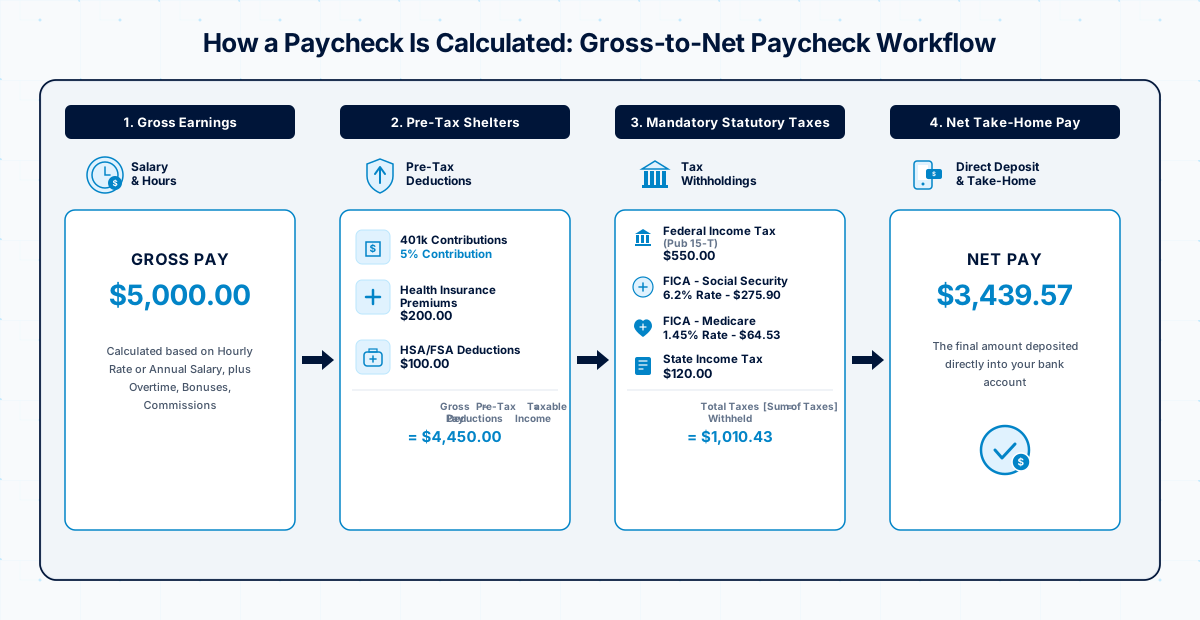
Gross Compensation
Total earnings agreed upon before any deductions, computed from annual base salary or hourly wage rate multiplied by regular and overtime hours worked.
Pre-Tax Shelters
Qualified IRC deductions including traditional 401(k), Section 125 health insurance, and HSAs subtracted first, shielding dollars from income tax liability.
Statutory Withholdings
Mandatory withholdings applied per IRS Pub 15 T (Federal Income Tax), 7.65% FICA (Social Security & Medicare), plus state and local municipal tax schedules.
Net Bank Deposit
The final spendable paycheck amount routed directly into your designated bank account via ACH direct deposit on your employer's scheduled pay frequency.
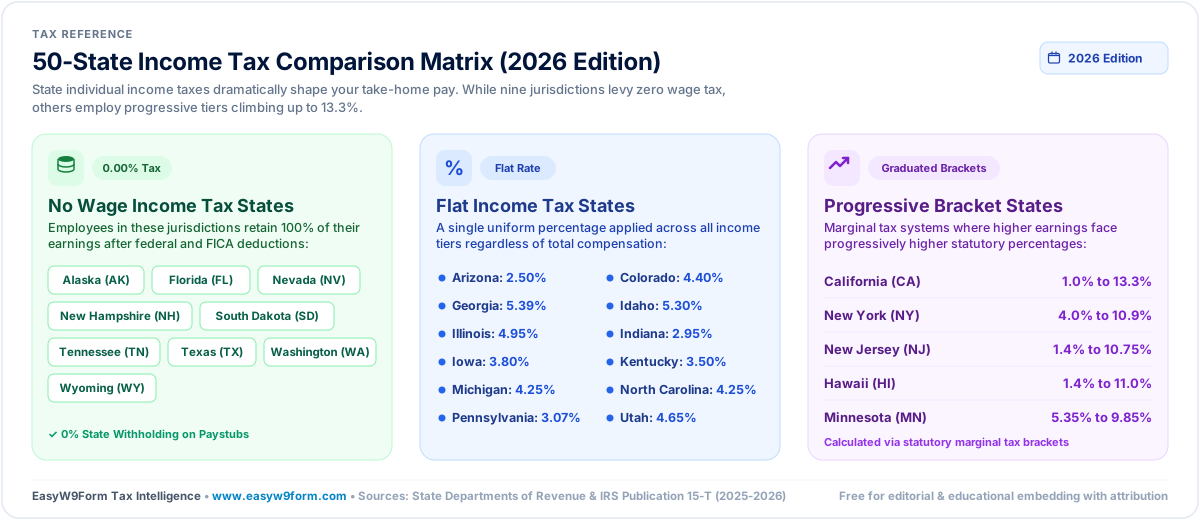
50-State Income Tax Comparison Matrix (2026 Edition)
The Anatomy of a Paycheck: What Every Deduction Means
Your pay stub is governed by Title 26 of the United States Code (Internal Revenue Code). Understanding statutory withholdings empowers taxpayers to prevent end-of-year tax shock, eliminate IRS underpayment penalties (IRC § 6654), and legally maximize cash flow.
FICA & Statutory Social Security
The Federal Insurance Contributions Act (FICA) levies two mandatory payroll deductions totaling 7.65% (learn more in our Paystub Tax Deductions Guide):
- 6.2% Social Security (OASDI): Applies strictly up to the annual statutory wage limit ($184,500 in 2026). Earnings above this threshold pay 0% Social Security tax.
- 1.45% Medicare (HI): Uncapped. Every dollar earned is subject to this base healthcare rate.
- 0.9% Additional Medicare: Mandated by the ACA for compensation exceeding $200,000 (Single) or $250,000 (Married Filing Jointly). Employers must withhold automatically once wages breach $200k.
Pre-Tax vs. Post-Tax Deductions
Not all deductions cost you dollar-for-dollar. See our guide to W-2 Box 12 Deduction Codes for reporting details:
Subtracted before federal and state income taxes are calculated. Contributing $100 typically only reduces your take-home pay by $72 to $78, delivering immediate 22%–28% statutory tax shielding.
Subtracted after all federal, state, and payroll taxes are computed. Contributing $100 reduces your paycheck by exactly $100 today, but enables tax-free distributions during retirement.
IRS Form W-4 Mechanics (Post-2020)
The IRS eliminated personal withholding allowances in 2020. Read our full IRS Form W-4 Guide or see W-9 vs. W-4 differences:
- Step 2 (Multiple Jobs): Accounts for a working spouse or secondary freelance job to prevent underwithholding into higher tax brackets.
- Step 3 (Dependents): Subtracts $2,200 per qualifying child (2026 OBBBA) directly from annual tax withholding, instantly boosting net pay per paycheck.
- Step 4(c) (Extra Withholding): Allows custom flat dollar deductions (e.g. $50/check) to offset investment earnings or 1099 side income.
6 Proven Strategies to Legally Boost Your Net Take-Home Pay
Rather than waiting 12 months for an IRS tax refund (which is effectively an interest-free loan to the federal government), use these statutory strategies to put more spendable cash into every paycheck.
Recalibrate Form W-4 Withholding
If you received a $3,600 IRS refund last April, you overwithheld roughly $300 every month. Submitting an updated Form W-4 with accurate deductions immediately reclaims that cash on every paycheck.
Maximize Triple-Advantaged HSAs
Health Savings Accounts (IRC § 223) avoid Federal Income Tax, State Income Tax, and FICA payroll tax (7.65%) when deducted via Section 125 cafeteria plans—beating 401(k) tax savings.
Audit Remote Work State Withholdings
Ensure your employer’s HR payroll software reflects your actual physical state of residence. Working remotely from Texas or Florida for a California firm shouldn't automatically incur CA withholding if you have no CA physical presence. Compare state rules on our 50-State Tax Guides.
Leverage Pre-Tax Commuter Benefits
IRC Section 132(f) permits up to $340/month in 2026 ($325/month in 2025) in pre-tax payroll transit and parking deductions. Paying for metro passes or garage parking via payroll directly slashes taxable gross wages.
Utilize Dependent Care FSAs
Allocate up to $5,000 per family into a Dependent Care Flexible Spending Account pre-tax for daycare, preschool, or eldercare expenses—generating up to $1,500+ in annual federal payroll tax savings.
Prepare for the Social Security “Pay Bump”
Earners making over $184,500 stop paying the 6.2% OASDI tax once their year-to-date earnings hit the wage base. Paychecks in late summer or autumn automatically surge by 6.2% until December 31. Check your effective brackets with our Federal Tax Bracket Engine.
Complementary IRS & Compliance Tools
Accelerate tax filing, contractor verification, and quarterly estimated prep.
Create official IRS Form W-9 PDFs with client-side cryptographic signatures.
Explore marginal vs effective federal tax rates for 2026 filings.
Calculate 15.3% SECA tax, business deductions, and quarterly vouchers.
Direct IRS and 50-state direct deposit statutory tracking portals.