Rhode Island Payroll & Tax Compliance Overview (2026)
Rhode Island individual payroll withholding is governed by R.I. Gen. Laws Title 44, Chapter 30 (Personal Income Tax) and administered by the Rhode Island Division of Taxation. State law enforces progressive income tax brackets, independent standard deductions, statutory personal exemptions, and the nation’s original employee-funded Temporary Disability Insurance (TDI) system under R.I. Gen. Laws § 28-39.
2026 Rhode Island Hourly Paycheck Conversion Table (40 Hours/Week)
Estimated annualized and bi-weekly take-home pay for hourly workers in Rhode Island across standard full-time hours (2,080 annual work hours). Computations incorporate 2026 IRS Publication 15-T federal withholding ($16,100 standard deduction), 7.65% federal FICA, 2026 Rhode Island progressive income tax ($11,200 standard deduction + $5,250 personal exemption), and the mandatory 1.10% RI TDI/TCI payroll deduction.
| Hourly Wage | Annual Gross | Federal FIT | FICA (7.65%) | RI State PIT | RI TDI (1.1%) | Annual Net | Bi-Weekly Net | Retention |
|---|---|---|---|---|---|---|---|---|
| $16.00/hr | $33,280.00 | -$1,823.10 | -$2,545.92 | -$631.13 | -$366.08 | $27,913.77 | $1,073.61 | 83.88% |
| $20.00/hr | $41,600.00 | -$2,758.00 | -$3,182.40 | -$943.13 | -$457.60 | $34,258.87 | $1,317.65 | 82.35% |
| $25.00/hr | $52,000.00 | -$4,408.00 | -$3,978.00 | -$1,333.13 | -$572.00 | $41,708.87 | $1,604.19 | 80.21% |
| $30.00/hr | $62,400.00 | -$5,656.00 | -$4,773.60 | -$1,723.13 | -$686.40 | $49,560.87 | $1,906.19 | 79.42% |
| $40.00/hr | $83,200.00 | -$9,474.00 | -$6,364.80 | -$2,503.13 | -$915.20 | $63,942.87 | $2,459.34 | 76.85% |
| $50.00/hr | $104,000.00 | -$14,768.00 | -$7,956.00 | -$3,338.13 | -$1,100.00 | $76,837.87 | $2,955.30 | 73.88% |
| $75.00/hr | $156,000.00 | -$26,728.00 | -$10,879.50 | -$5,808.13 | -$1,100.00 | $111,484.37 | $4,287.86 | 71.46% |
| $100.00/hr | $208,000.00 | -$39,208.00 | -$13,382.40 | -$8,352.13 | -$1,100.00 | $145,957.47 | $5,613.75 | 70.17% |
2026 Rhode Island Salary Take-Home Pay Benchmarks ($30k – $250k)
Itemized statutory breakdown for Single salaried filers claiming standard state allowances ($11,200 standard deduction + $5,250 personal exemption). Demonstrates the progression from the bottom 3.75% bracket through the 4.75% tier ($82,051+) to the 5.99% marginal rate ($186,351+), and illustrates how the 1.10% TDI contribution caps out at $1,100.00 above $100,000.
| Gross Salary | Federal FIT | FICA (7.65%) | RI State PIT | RI TDI (1.1%) | Annual Take-Home | Monthly | Bi-Weekly | Effective Tax |
|---|---|---|---|---|---|---|---|---|
| $30,000 | -$1,390.00 | -$2,295.00 | -$508.13 | -$330.00 | $25,476.87 | $2,123.07 | $979.88 | 15.08% |
| $50,000 | -$4,168.00 | -$3,825.00 | -$1,258.13 | -$550.00 | $40,198.87 | $3,349.91 | $1,546.11 | 19.60% |
| $75,000 | -$7,670.00 | -$5,737.50 | -$2,195.63 | -$825.00 | $58,571.87 | $4,880.99 | $2,252.76 | 21.90% |
| $100,000 | -$13,808.00 | -$7,650.00 | -$3,148.13 | -$1,100.00 | $74,293.87 | $6,191.16 | $2,857.46 | 25.71% |
| $150,000 | -$25,288.00 | -$11,475.00 | -$5,523.13 | -$1,100.00 | $106,613.87 | $8,884.49 | $4,100.53 | 28.92% |
| $200,000 | -$37,288.00 | -$14,339.00 | -$7,898.13 | -$1,100.00 | $139,374.87 | $11,614.57 | $5,360.57 | 30.31% |
| $250,000 | -$50,588.00 | -$15,064.00 | -$10,858.41 | -$1,100.00 | $172,389.59 | $14,365.80 | $6,630.37 | 31.04% |
Step-by-Step Gross-to-Net Walkthrough: $75,000 Rhode Island Salary
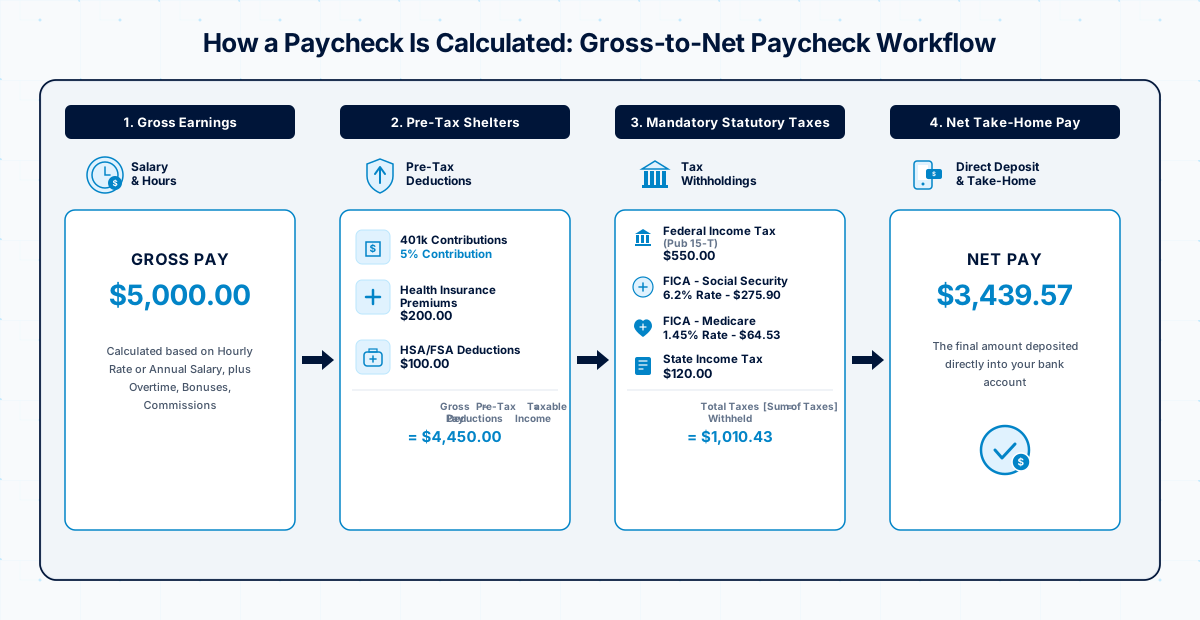
The following audit trace details how automated payroll systems compute take-home pay for an unmarried worker earning an annual salary of $75,000.00 paid bi-weekly (26 pay periods per year) in Rhode Island:
- Gross Paycheck Assessment: Gross annual salary of $75,000.00 divided across 26 pay periods yields $2,884.62 gross per bi-weekly paycheck.
- Federal Income Tax Withholding (IRS Pub. 15-T Worksheet 1A): Under standard single filing withholding with no extra allowances, federal withholding equals $7,670.00 annually, or $295.00 per bi-weekly paycheck.
- FICA Payroll Withholding:
- Social Security (6.20% on $75,000): $4,650.00/yr ($178.85 bi-weekly).
- Medicare (1.45% on $75,000): $1,087.50/yr ($41.83 bi-weekly).
- Total FICA: $5,737.50 annually ($220.67 bi-weekly).
- Rhode Island Personal Income Tax (R.I. Gen. Laws § 44-30-2.6):
- Gross Income: $75,000.00
- Rhode Island Standard Deduction: -$11,200.00
- Rhode Island Personal Exemption: -$5,250.00
- Rhode Island Taxable Income: $75,000.00 − $16,450.00 = $58,550.00
- Because $58,550.00 is below the $82,050 threshold, 100% of taxable income falls within Tier 1 (3.75%).
- Calculation: $58,550.00 × 3.75% = $2,195.63 annually ($84.45 bi-weekly).
- Rhode Island Temporary Disability Insurance (R.I. Gen. Laws § 28-39):
- Statutory 2026 TDI Rate: 1.10% (0.0110) on gross compensation up to $100,000.
- Calculation: $75,000.00 × 1.10% = $825.00 annually ($31.73 bi-weekly).
- Local Municipal Wage Tax: Zero (0.00%) local income taxes statewide = $0.00.
- Net Take-Home Pay Result:Total Deductions: $7,670.00 (Fed) + $5,737.50 (FICA) + $2,195.63 (RI PIT) + $825.00 (RI TDI) = $16,428.13Net Annual Take-Home: $75,000.00 − $16,428.13 = $58,571.88Bi-Weekly Direct Deposit: $2,252.76 | Effective Tax Rate: 21.90% | Retention: 78.10%
New England Regional Comparison: $100,000 Salary After Taxes
How Rhode Island’s state tax structure compares against neighboring New England states on a $100,000 annual gross salary for a single filer claiming standard deductions.
| State Jurisdiction | Statutory Rates | State Income Tax | State TDI / PFML | Fed + FICA | Net Take-Home | Differential vs RI |
|---|---|---|---|---|---|---|
| Rhode Island | 3.75% – 5.99% Graduated | $3,148 | $1,100 (TDI/TCI) | $21,458 | $74,294 | Baseline (Ocean State) |
| Massachusetts | 5.00% Flat + 0.46% PFML | $4,780 | $460 (PFML) | $21,458 | $73,302 | -$992 in Massachusetts |
| Connecticut | 2.00% – 6.99% + 0.50% CTPL | $4,570 | $500 (CTPL) | $21,458 | $73,472 | -$822 in Connecticut |
| New Hampshire | 0.00% (No Wage Tax) | $0 | $0 | $21,458 | $78,542 | +$4,248 in New Hampshire |
| Maine | 5.80% – 7.15% + 0.50% PFML | $4,810 | $500 (PFML) | $21,458 | $73,232 | -$1,062 in Maine |
Rhode Island Municipal Tax Directory (All 39 Cities & Towns)
Rhode Island state law preempts local personal wage taxes. Unlike Pennsylvania, Ohio, or Maryland, workers in Rhode Island do NOT pay local municipal or school district wage withholdings.
| Municipality | County | Local Wage Tax | State TDI Applies | 2026 Min. Wage | Compliance Status |
|---|---|---|---|---|---|
| Providence | Providence County | 0.00% | Yes (1.10%) | $16.00/hr | 0% Municipal Income Tax |
| Warwick | Kent County | 0.00% | Yes (1.10%) | $16.00/hr | 0% Municipal Income Tax |
| Cranston | Providence County | 0.00% | Yes (1.10%) | $16.00/hr | 0% Municipal Income Tax |
| Pawtucket | Providence County | 0.00% | Yes (1.10%) | $16.00/hr | 0% Municipal Income Tax |
| East Providence | Providence County | 0.00% | Yes (1.10%) | $16.00/hr | 0% Municipal Income Tax |
| Woonsocket | Providence County | 0.00% | Yes (1.10%) | $16.00/hr | 0% Municipal Income Tax |
| Newport | Newport County | 0.00% | Yes (1.10%) | $16.00/hr | 0% Municipal Income Tax |
| Westerly | Washington County | 0.00% | Yes (1.10%) | $16.00/hr | 0% Municipal Income Tax |
Cross-Border Commuters: Massachusetts & Connecticut Tax Interaction
Because Rhode Island maintains no income tax reciprocity agreements with any other state, tens of thousands of workers commuting along the I-95 corridor face multi-state filing obligations:
Rhode Island Residents Working in Massachusetts
Massachusetts taxes nonresidents on wages earned for services performed inside Massachusetts (flat 5.00%). Employers withhold Massachusetts state tax. At year-end, the worker files MA Form 1-NR/PY as a nonresident, and files RI Form RI-1040 as a resident. Under R.I. Gen. Laws § 44-30-18, Rhode Island provides an out-of-state tax credit on Schedule II for taxes paid to Massachusetts, preventing double taxation.
Rhode Island Residents Working in Connecticut
Connecticut employers withhold CT income tax (2.0%–6.99%). The worker files CT Form CT-1040NR/PY as a nonresident, and reports all worldwide income on RI Form RI-1040. Rhode Island Schedule II credit offsets the RI tax liability dollar-for-dollar up to the amount of RI tax that would have been due on that income.
Frequently Asked Questions: Rhode Island Paycheck & Payroll Taxes
What are the Rhode Island personal income tax rates and brackets for 2026 under R.I. Gen. Laws § 44-30-2.6?
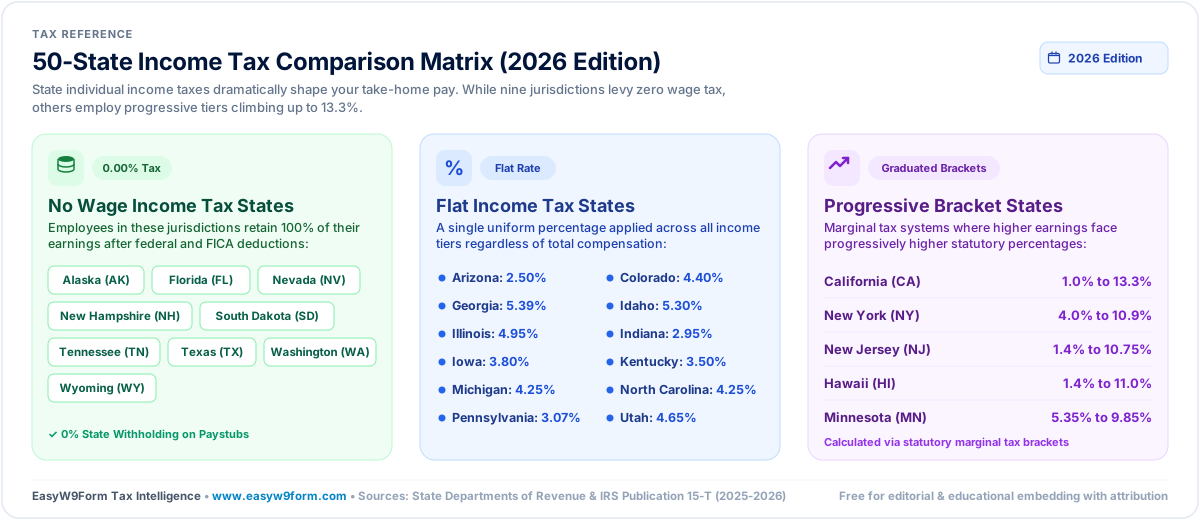
Under R.I. Gen. Laws § 44-30-2.6, Rhode Island levies progressive individual income taxes across three statutory tax brackets. For tax year 2026, the inflation-adjusted brackets are: 3.75% on taxable income up to $82,050; 4.75% on taxable income between $82,051 and $186,350; and 5.99% on taxable income exceeding $186,350 ($79,900 and $181,650 thresholds in 2025). These brackets apply uniformly across Single, Married Filing Jointly, Head of Household, and Married Filing Separately statuses.
What is the Rhode Island standard deduction and personal exemption for the 2026 tax year?
Under R.I. Gen. Laws § 44-30-2.6(c), Rhode Island provides its own state standard deduction: for 2026, it is $11,200 for Single and Married Filing Separately, $22,400 for Married Filing Jointly, and $16,800 for Head of Household ($10,900 Single / $21,800 MFJ in 2025). In addition, taxpayers claim a statutory personal exemption of $5,250 per person ($10,500 MFJ; $5,100 in 2025). Rhode Island does NOT allow federal itemized deductions; all filers must claim the state standard deduction.
How does the Rhode Island personal exemption and standard deduction phaseout work for high earners?
Under R.I. Gen. Laws § 44-30-2.6(d), both the Rhode Island standard deduction and personal exemption begin phasing out once a taxpayer’s modified federal adjusted gross income exceeds $261,000 for 2026 ($254,450 for 2025). The allowances are reduced proportionally and are completely eliminated once income reaches $290,800 ($283,500 for 2025). Taxpayers in this phaseout band must complete the Exemption Worksheet in the Form RI-1040 booklet.
What is the Rhode Island Temporary Disability Insurance (TDI) and Temporary Caregiver Insurance (TCI) deduction?
Rhode Island was the first state in the nation to create Temporary Disability Insurance (in 1942). Governed by R.I. Gen. Laws § 28-39 and § 28-40, TDI/TCI provides wage-replacement benefits for off-the-job sickness, pregnancy, and family caregiving. The program is funded 100% by employee payroll deductions with ZERO employer contribution. For calendar year 2026, the statutory deduction rate is 1.10% on gross wages up to the taxable wage base cap of $100,000, resulting in a maximum annual employee deduction of $1,100.00 (down from 1.30% on an $89,200 cap, or $1,159.60 max, in 2025).
Can I get a refund if I overpaid Rhode Island TDI tax working multiple jobs?
Yes. If you work for more than one employer during the calendar year and your combined gross compensation exceeds the annual TDI taxable wage base ($100,000 in 2026), your employers will have collectively withheld more than the statutory maximum of $1,100.00. You can claim a full refund of the excess TDI tax paid by filing Form TX-16 (Claim for Refund of Temporary Disability Insurance Tax) with the Rhode Island Department of Labor and Training (DLT) Employer Tax Unit.
Do any cities or towns in Rhode Island levy local municipal personal income taxes?
No. Rhode Island state law prohibits local municipalities, towns, or counties from levying local personal income taxes, earnings taxes, or commuter wage taxes. Residents and workers across Providence, Warwick, Cranston, Pawtucket, Newport, and all 39 cities and towns pay 0.00% local income tax. Municipal operations are financed through local property taxes and state revenue sharing.
What is the Rhode Island statewide minimum wage and tipped cash wage for 2026?
Under R.I. Gen. Laws § 28-12-3, Rhode Island’s minimum wage increased to $16.00 per hour effective January 1, 2026 (up from $15.00 in 2025). The statute schedules a further increase to $17.00 per hour on January 1, 2027. For tipped employees, the mandatory direct cash wage floor is $3.89 per hour, allowing a maximum tip credit of $12.11 per hour. Employers must ensure that direct cash wages plus gratuities equal at least $16.00 per hour; any shortfall must be made up by the employer.
Which state withholding form is used in Rhode Island?
Employees in Rhode Island must submit Form RI W-4 (Employee’s Withholding Allowance Certificate) to their employer upon hire or when updating withholding. Federal Form W-4 cannot be used for Rhode Island state withholding. For 2026, each personal allowance claimed on Form RI W-4 is valued at $1,000 annually ($38.46 bi-weekly). Allowances phase out for annualized earnings over $261,000 and are fully eliminated above $290,800.
Does Rhode Island have an income tax reciprocity agreement with Massachusetts or Connecticut?
No. Rhode Island maintains ZERO multi-state reciprocal income tax agreements. If you live in Rhode Island and commute to work in Massachusetts (or vice versa), compensation is subject to Massachusetts nonresident income tax. You must file a Massachusetts nonresident return (Form 1-NR/PY) and file a Rhode Island resident return (Form RI-1040). Under R.I. Gen. Laws § 44-30-18, Rhode Island grants a resident credit on Schedule II for income taxes paid to other states, preventing double taxation on the same wage income.
How are traditional 401(k), 403(b), and Section 125 cafeteria benefits taxed in Rhode Island?
Rhode Island conforms to federal Internal Revenue Code definitions of adjusted gross income. Traditional 401(k), 403(b), and 457(b) elective deferrals reduce federal and Rhode Island state taxable income (reducing Box 1 and Box 16 wages). Qualifying Section 125 deductions (health, dental, vision insurance premiums, and HSA contributions) reduce federal income tax, Rhode Island state income tax, federal FICA, and Rhode Island TDI/TCI contributions.
What is the supplemental wage withholding rate in Rhode Island for bonuses and commissions?
Under the Rhode Island Division of Taxation Employer’s Income Tax Withholding Tables, the statutory withholding rate for supplemental wage payments—including annual bonuses, severance packages, commission disbursements, and equity vesting—is the state’s top marginal rate of 5.99%. Employers may withhold at this flat rate when supplemental wages are paid separately from regular wages.
When is the Rhode Island state personal income tax return Form RI-1040 due?
Rhode Island individual income tax returns (Form RI-1040 for residents and Form RI-1040NR for nonresidents) are due on April 15 following the close of the calendar year (or the next business day if April 15 falls on a weekend or state holiday). An automatic 6-month extension to October 15 is granted by filing Form RI-4868, though at least 80% of total tax liability must be remitted by April 15 to avoid late-payment penalties and statutory interest.