South Carolina Payroll & Tax Compliance Overview (2026)
South Carolina individual payroll withholding is governed by S.C. Code Ann. Title 12, Chapter 6 and administered by the South Carolina Department of Revenue (SCDOR). Beginning in tax year 2026, Act 110 enacted major structural reforms (detailed in SC Information Letter #26-20), replacing the historical graduated tiers with a streamlined two-bracket system, reducing the top rate to 5.21%, and establishing the South Carolina Income Adjusted Deduction (SCIAD).
2026 South Carolina Hourly Paycheck Conversion Table (40 Hours/Week)
Estimated annualized and bi-weekly take-home pay for hourly workers in South Carolina across full-time hours (2,080 annual work hours). Computations incorporate 2026 IRS Publication 15-T federal withholding ($16,100 standard deduction), 7.65% federal FICA, South Carolina Act 110 income tax ($15,000 SCIAD base deduction, 1.99% bottom rate, 5.21% top rate), and 0% local taxes.
| Hourly Wage | Annual Gross | Federal FIT | FICA (7.65%) | SC State Tax | Annual Net | Bi-Weekly Net | Retention |
|---|---|---|---|---|---|---|---|
| $7.25/hr | $15,080.00 | -$0.00 | -$1,153.62 | -$1.59 | $13,924.79 | $535.57 | 92.34% |
| $10.00/hr | $20,800.00 | -$470.00 | -$1,591.20 | -$115.42 | $18,623.38 | $716.28 | 89.54% |
| $15.00/hr | $31,200.00 | -$1,510.00 | -$2,386.80 | -$322.38 | $26,980.82 | $1,037.72 | 86.48% |
| $20.00/hr | $41,600.00 | -$2,758.00 | -$3,182.40 | -$529.34 | $35,130.26 | $1,351.16 | 84.45% |
| $25.00/hr | $52,000.00 | -$4,408.00 | -$3,978.00 | -$961.70 | $42,652.30 | $1,640.47 | 82.02% |
| $30.00/hr | $62,400.00 | -$5,656.00 | -$4,773.60 | -$1,503.54 | $50,466.86 | $1,941.03 | 80.88% |
| $40.00/hr | $83,200.00 | -$9,474.00 | -$6,364.80 | -$2,587.22 | $64,773.98 | $2,491.31 | 77.85% |
| $50.00/hr | $104,000.00 | -$14,768.00 | -$7,956.00 | -$3,670.90 | $77,605.10 | $2,984.81 | 74.62% |
| $75.00/hr | $156,000.00 | -$26,728.00 | -$10,879.50 | -$6,380.10 | $112,012.40 | $4,308.17 | 71.80% |
| $100.00/hr | $208,000.00 | -$39,208.00 | -$13,382.40 | -$9,089.30 | $146,320.30 | $5,627.70 | 70.35% |
2026 South Carolina Salary Take-Home Pay Benchmarks ($30k – $250k)
Itemized statutory breakdown for Single salaried filers claiming the $15,000 SCIAD base deduction. Demonstrates how Act 110 of 2026 applies the low 1.99% rate across the first $30,000 of taxable earnings and the reduced top rate of 5.21% thereafter.
| Gross Salary | Federal FIT | FICA (7.65%) | SC State Tax | Annual Take-Home | Monthly | Bi-Weekly | Effective Tax |
|---|---|---|---|---|---|---|---|
| $30,000 | -$1,390.00 | -$2,295.00 | -$298.50 | $26,016.50 | $2,168.04 | $1,000.63 | 13.28% |
| $50,000 | -$4,168.00 | -$3,825.00 | -$857.50 | $41,149.50 | $3,429.13 | $1,582.67 | 17.70% |
| $75,000 | -$7,670.00 | -$5,737.50 | -$2,160.00 | $59,432.50 | $4,952.71 | $2,285.87 | 20.76% |
| $100,000 | -$13,808.00 | -$7,650.00 | -$3,462.50 | $75,079.50 | $6,256.63 | $2,887.67 | 24.92% |
| $150,000 | -$25,288.00 | -$11,475.00 | -$6,067.50 | $107,169.50 | $8,930.79 | $4,121.90 | 28.55% |
| $200,000 | -$37,288.00 | -$14,339.00 | -$8,672.50 | $139,700.50 | $11,641.71 | $5,373.10 | 30.15% |
| $250,000 | -$50,588.00 | -$15,064.00 | -$11,277.50 | $173,070.50 | $14,422.54 | $6,656.56 | 30.77% |
Step-by-Step Gross-to-Net Walkthrough: $75,000 South Carolina Salary
The following audit trace demonstrates how automated payroll software calculates net pay for an unmarried employee earning an annual salary of $75,000.00 paid bi-weekly (26 pay periods per year) in South Carolina under Act 110:
- Gross Paycheck Assessment: Gross annual salary of $75,000.00 divided by 26 pay periods equals $2,884.62 gross per bi-weekly paycheck.
- Federal Income Tax Withholding (IRS Pub. 15-T Worksheet 1A): Under standard single filing withholding ($16,100 standard deduction), federal withholding equals $7,670.00 annually, or $295.00 bi-weekly.
- Federal FICA Payroll Deductions:
- Social Security (6.20% on $75,000): $4,650.00/yr ($178.85 bi-weekly).
- Medicare (1.45% on $75,000): $1,087.50/yr ($41.83 bi-weekly).
- Total FICA: $5,737.50 annually ($220.67 bi-weekly).
- South Carolina State Income Tax (Act 110 / S.C. Code Ann. § 12-6-510):
- Federal AGI Baseline: $75,000.00
- South Carolina Income Adjusted Deduction (SCIAD): -$15,000.00
- South Carolina Taxable Income: $75,000.00 − $15,000.00 = $60,000.00
- Tier 1 (1.99% on first $30,000): $30,000.00 × 1.99% = $597.00
- Tier 2 (5.21% on remaining $30,000): $30,000.00 × 5.21% = $1,563.00
- Total SC State Tax: $597.00 + $1,563.00 = $2,160.00 annually ($83.08 bi-weekly).
- SCDOR Shortcut Formula Verification: (5.21% × $60,000) − $966 = $3,126.00 − $966.00 = $2,160.00.
- Local Municipal Wage Tax & State Disability:
- Local Municipal Income Tax: $0.00 (0.00% statewide).
- State Employee Disability / PFML: $0.00 ($0.00 statewide).
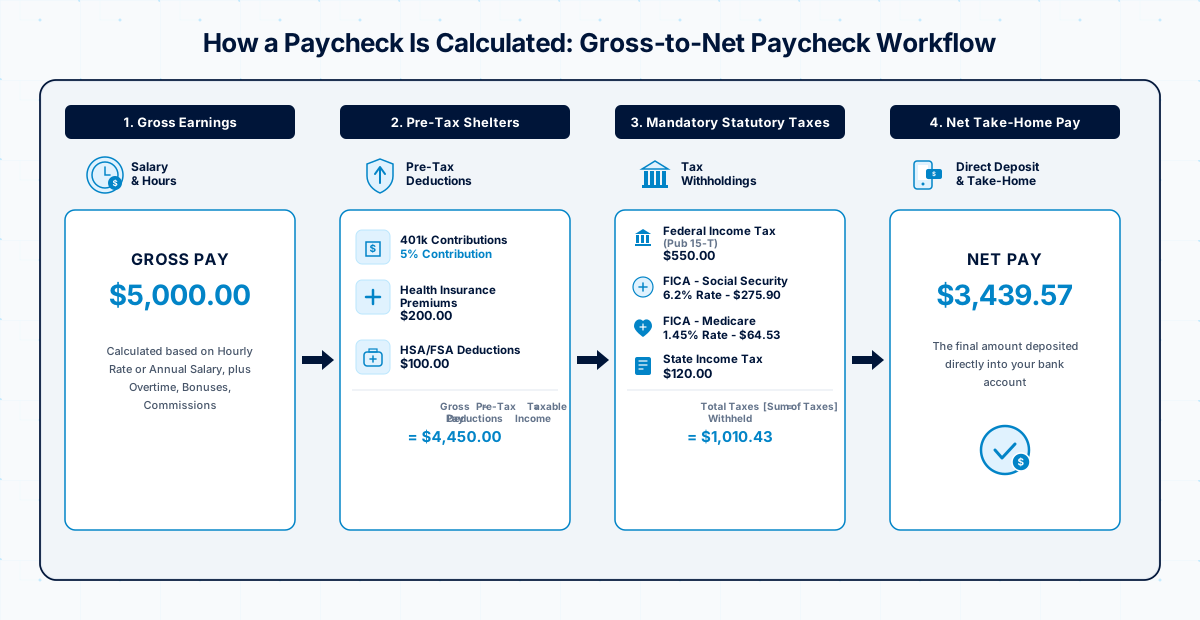
- Net Take-Home Pay Result:Total Deductions: $7,670.00 (Fed) + $5,737.50 (FICA) + $2,160.00 (SC Tax) = $15,567.50Net Annual Take-Home: $75,000.00 − $15,567.50 = $59,432.50Bi-Weekly Direct Deposit: $2,285.87 | Effective Tax Rate: 20.76% | Retention: 79.24%
Southeast Regional Comparison: $100,000 Salary After Taxes
How South Carolina’s Act 110 tax reform compares against neighboring Southeastern states on a $100,000 annual gross salary for a single filer claiming standard deductions.
| State Jurisdiction | Statutory Rates | State Income Tax | Local Tax | Fed + FICA | Net Take-Home | Differential vs SC |
|---|---|---|---|---|---|---|
| South Carolina | 1.99% & 5.21% (Act 110) | $3,463 | $0 | $21,458 | $75,080 | Baseline (Palmetto State) |
| North Carolina | 3.99% Flat Rate | $3,481 | $0 | $21,458 | $75,061 | -$19 in North Carolina |
| Georgia | 4.99% Flat Rate (HB 1015) | $4,242 | $0 | $21,458 | $74,300 | -$780 in Georgia |
| Virginia | 2.00% – 5.75% Graduated | $4,936 | $0 | $21,458 | $73,606 | -$1,474 in Virginia |
| Florida | 0.00% (No State Tax) | $0 | $0 | $21,458 | $78,542 | +$3,462 in Florida |
| Tennessee | 0.00% (No State Tax) | $0 | $0 | $21,458 | $78,542 | +$3,462 in Tennessee |
South Carolina Municipal Tax Directory (All 46 Counties)
Under South Carolina state law, municipal corporations and counties are prohibited from levying local personal income taxes. Workers across Charleston, Columbia, Greenville, and all 46 counties pay 0.00% local income tax.
| Municipality | County | Local Wage Tax | State Income Tax | 2026 Min. Wage | Compliance Status |
|---|---|---|---|---|---|
| City of Charleston | Charleston County | 0.00% | 1.99% – 5.21% | $7.25/hr | 0% Local Income Tax |
| City of Columbia | Richland County | 0.00% | 1.99% – 5.21% | $7.25/hr | 0% Local Income Tax |
| City of Greenville | Greenville County | 0.00% | 1.99% – 5.21% | $7.25/hr | 0% Local Income Tax |
| Town of Mount Pleasant | Charleston County | 0.00% | 1.99% – 5.21% | $7.25/hr | 0% Local Income Tax |
| City of Rock Hill | York County | 0.00% | 1.99% – 5.21% | $7.25/hr | 0% Local Income Tax |
| Town of Summerville | Dorchester County | 0.00% | 1.99% – 5.21% | $7.25/hr | 0% Local Income Tax |
| City of Spartanburg | Spartanburg County | 0.00% | 1.99% – 5.21% | $7.25/hr | 0% Local Income Tax |
| City of Myrtle Beach | Horry County | 0.00% | 1.99% – 5.21% | $7.25/hr | 0% Local Income Tax |
Frequently Asked Questions: South Carolina Paycheck & Payroll Taxes
What are the South Carolina personal income tax rates and brackets for 2026 under Act 110?
Under Act 110 of 2026 (codified in S.C. Code Ann. § 12-6-510 and explained in SC Information Letter #26-20), South Carolina restructured its individual income tax into a simplified two-bracket system for tax years beginning after December 31, 2025. Taxable income from $0 to $29,999 is taxed at a low rate of 1.99%. Taxable income of $30,000 or more is taxed at a top marginal rate of 5.21% (computed as: 5.21% × taxable income minus $966). This replaces the prior 3-tier structure which had a top marginal rate of 6.00% in 2025.
What is the South Carolina Income Adjusted Deduction (SCIAD) and how does it work?
Established by Act 110 of 2026, the South Carolina Income Adjusted Deduction (SCIAD) permanently replaces the federal standard deduction for South Carolina individual income tax. Under this reform, state taxable income calculation begins with Federal Adjusted Gross Income (AGI) rather than federal taxable income. The baseline SCIAD deduction is $15,000 for Single and Married Filing Separately filers, $30,000 for Married Filing Jointly and Surviving Spouses, and $22,500 for Head of Household. Nonresidents reduce their SCIAD proportionally based on their ratio of SC gross income to total federal gross income.
Does South Carolina allow federal itemized deductions on the state return?
No. As part of the comprehensive tax reform enacted in Act 110, South Carolina decoupled from Internal Revenue Code Sections 63(b) through (g). Federal itemized deductions (such as mortgage interest, state and local taxes, and charitable contributions) are no longer deducted on Form SC1040. Instead, all individual taxpayers receive the standardized South Carolina Income Adjusted Deduction (SCIAD).
Do any cities or counties in South Carolina levy local municipal income or wage taxes?
No. South Carolina state law strictly prohibits local governments, cities, and counties from imposing local personal income taxes, earnings taxes, or municipal payroll taxes. Workers across Charleston, Columbia, Greenville, Mount Pleasant, Rock Hill, and all 46 counties pay 0.00% local income tax. Local municipal budgets are funded through local property taxes, business license fees, and local option sales taxes.
Does South Carolina mandate employee payroll deductions for disability (SDI) or paid family leave (PFML)?
No. South Carolina does not operate a state-mandated disability insurance program or a state-administered paid family and medical leave program for private-sector employees. There are zero state employee payroll deductions for SDI, TDI, or PFML on South Carolina paystubs. State Unemployment Insurance (SUI) is funded 100% by employer contributions with zero employee deduction.
What is the statutory minimum wage and tipped minimum wage in South Carolina for 2026?
South Carolina does not have a separate state minimum wage statute and operates under the federal Fair Labor Standards Act (FLSA) pursuant to S.C. Code Ann. § 41-10-10 et seq. The minimum wage is $7.25 per hour for non-exempt hourly employees. For tipped employees, employers may pay a direct cash wage of $2.13 per hour, claiming an allowable tip credit of $5.12 per hour (provided direct cash wages plus tips equal at least $7.25/hr). Under S.C. Code Ann. § 6-1-130, local municipalities are legally preempted from setting higher minimum wage rates.
Which state tax withholding certificate is used in South Carolina?
Employees in South Carolina must submit Form SC W-4 (South Carolina Employee’s Withholding Allowance Certificate) to their employer upon hire or when adjusting state withholding. Employers use the allowances claimed on Form SC W-4 in conjunction with SCDOR withholding formula WH-1603F. Under the formula, each personal allowance is valued at $5,000 annually ($192.31 bi-weekly), and an automatic standard deduction allowance is granted for employees claiming one or more allowances.
How does South Carolina tax traditional 401(k), 403(b), and Section 125 cafeteria plan contributions?
South Carolina conforms to federal Internal Revenue Code rules regarding pre-tax employee benefit deductions. Elective deferrals to traditional 401(k), 403(b), and 457 retirement plans reduce federal taxable income and South Carolina state taxable income (reducing Box 1 and Box 16 on Form W-2). Qualifying Section 125 deductions—such as employer-sponsored medical, dental, and vision insurance premiums, and HSA contributions—reduce federal income tax, South Carolina state income tax, and federal FICA payroll taxes.
How are cross-border commuters taxed between South Carolina, North Carolina, and Georgia?
South Carolina does not have reciprocal income tax agreements with North Carolina or Georgia. If you live in South Carolina and commute to work in Charlotte (NC) or Augusta (GA), your wages are subject to nonresident income tax in the state where the work is physically performed. You must file a nonresident return in that state and file a resident return (Form SC1040) in South Carolina. Under S.C. Code Ann. § 12-6-3400, South Carolina grants a resident credit on Form SC1040TC for income taxes paid to another state, preventing double taxation on the same earnings.
What is the military spouse exemption from South Carolina withholding under the SCRA?
Under the federal Servicemembers Civil Relief Act (SCRA) as amended by the Military Spouses Residency Relief Act (MSRRA) and the Veterans Benefits and Transition Act, a civilian spouse of an active-duty servicemember stationed in South Carolina can claim complete exemption from South Carolina state income tax withholding on Form SC W-4 (Line 6). To qualify, the spouse must share the same legal state of residence as the servicemember and be present in South Carolina solely to accompany the servicemember on military orders.
What is the supplemental wage withholding rate in South Carolina for bonuses and commissions?
Under SCDOR withholding rules, when supplemental wages (such as annual bonuses, sales commissions, overtime premiums, or severance payments) are paid separately from regular wages, employers may withhold state income tax at South Carolina’s top marginal rate of 5.21% (reduced from 6.00% under Act 110).
When is the South Carolina state individual income tax return Form SC1040 due?
South Carolina individual income tax returns (Form SC1040) are due on April 15 following the close of the calendar year (or the next business day if April 15 falls on a weekend or state holiday). An automatic 6-month extension to October 15 is available by filing federal Form 4868 or SC Form SC4868. However, an extension to file is not an extension to pay; at least 90% of state tax liability must be remitted by April 15 to avoid late-payment interest and statutory penalties.